
During the virtual meet, Biden and Modi will discuss cooperation on a range of issues, including ending the COVID-19 pandemic, countering the climate crisis, strengthening the global economy, and upholding a free, open, rules-based international order to bolster security, democracy, and prosperity in the Indo-Pacific, White House Press Secretary Jen Psaki said.
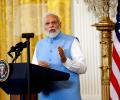
India believes in sabka saath, sabka vikas, sabka vishwas, sabka prayaas and walks ahead with it, Modi said.

For India to reach its ambiguous economic growth targets, it needs to be integrated into global trade pacts.

India and the US on Sunday agreed to enhance their engagement on intellectual property rights, a vexed issue between the two countries.

Here is the full text of the joint statement issued by India and the US.

India has a 'natural global partnership' with US, says PM.

MEA Spokesperson Arindam Bagchi said the forthcoming Quad summit will provide an opportunity for the Quad leaders to exchange views about developments in the Indo-Pacific and contemporary global issues of mutual interest.

White House Press Secretary Karine Jean-Pierre said the upcoming visit will affirm the deep and close partnership between the United States and India.

There was a discussion on trade matters, market access, regulatory issues and barriers. Both leaders underlined the importance of free and fair trade
The US pharma industry has expressed concern over deteriorating intellectual property environment in India, alleging that patent rights in the country are unreasonably denied.The US pharma industry has expressed concern over deteriorating intellectual property environment in India, alleging that patent rights in the country are unreasonably denied.
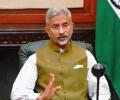
External Affairs Minister S Jaishankar will arrive in New York on Sunday to participate in the high-level 77th session of the UN General Assembly, which kicks off on September 20 with the opening of the general debate.
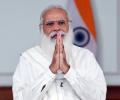
The main elements of the programme are bilateral meetings with the US leadership, participation in the Quad Leaders' Summit, address at the UN General Assembly and business interactions.

Describing the just concluded United States visit of Prime Minister Narendra Modi as extraordinarily successful, the White House has said that his meeting with President Barack Obama has re-energised the strategic relationship between the two largest democracies of the world.
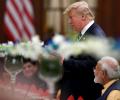
Modi may take satisfaction from his display of considerable political skill in managing a mercurial, temperamental and unpredictable US president and nudging him into uncharacteristic restraint and even carefully orchestrated remarks. This personal chemistry will come in handy if Trump returns as president in the November elections, says former foreign secretary Shyam Saran.

In his message on the occasion of 'International Day Against Nuclear Tests', UN Secretary General Ban Ki-moon said "we urgently need new progress in achieving a world free of both nuclear tests and nuclear weapons," which are increasingly being viewed as "dangerous relics of the Cold War" and are "long overdue for permanent retirement".
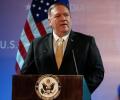
"Whenever we do compromise those rights, the world is worse off," Pompeo said.

The elephant in the room will permeate the conversations, predicts Rup Narayan Das.

The prime minister and president stated their intention to expand defence co-operation to bolster national, regional and global security.

Modi will have a number of high-profile multilateral and bilateral meetings with global leaders including United States Vice President Mike Pence and Singapore premier Lee Hsein Loong.
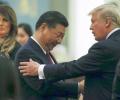
'While many Chinese policy makers dismiss the political, economic and technological component of US-India relations, they express caution on the defence-related ties which also happens to be a major driver in US-India relations,' explains China expert Srikanth Kondapalli.

India cannot choose its geography and devise regional strategies to dovetail into the Western Indian Ocean hypothesis conceived in the Pentagon, argues Ambassador M K Bhadrakumar.

'The credit for managing Trump should go to Modi.' 'Biden is a predictable and rational person with plenty of administrative experience,' notes Ambassador T P Sreenivasan.

'This is a historic juncture when the US is in great need of an alliance with India to strengthen its hands in the fierce struggle with China in the Asian theatre,' points out Ambassador M K Bhadrakumar.

The joint statement issued after Prime Minister Narendra Modi and President Barack Obama's first-ever summit is high on intent and ambition. Notably missing from the statement is India's refusal to be America's partner in its war against ISIS.

'Alas, the Congress party offers no suggestions as to how to unscramble the omlette it cooked during 2004-2014 on which the Modi government may have since lavishly spread some tomato ketchup,' says Ambassador M K Bhadrakumar.

United States President Barack Obama will have a tight schedule during his three-day visit starting January 25, as he will hold talks with top leadership in New Delhi on ways to make progress on key issues like defence and civil nuclear agreement and attend the Republic Day celebrations as the chief guest, among other engagements.

Defence Minister Manohar Parrikar expects to see progress in India-US defence relations at the speed of a year per month.
India needs to have a re-look of whole gamut of its relations with major powers and also prepare for a more turbulent neighbourhood. But such is the tyranny of Indian status quo mindset that any talk of re-look at nuclear doctrine or foreign relations is treated as blasphemy, says Colonel (retd) Anil Athale.

Moving ahead with their new mantra -- Chalein Saath Saath: Forward Together We Go -- Prime Minister Narendra Modi and United States President Barack Obama on Tuesday vowed to deepen cooperation in every sector for the benefit of global stability and people's livelihoods over the next ten years.

Tillerson said the US will provide India with best technologies for its military modernisation which include offers to supply F-16 and F-18 fighter jets.
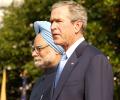
'If we could break through this symbolic barrier of sanctions and a dysfunctional relationship, we could do anything.'

'To expect that he has a magic wand to resolve all differences and announce breakthroughs in all issues during his first visit to the US is to be unrealistic,' says Ambassador T P Sreenivasan.

Even as the United States snuggles closer to India with the thinly veiled objective of containing China, the Indian strategy is to avoid alienating either nation.

'The US wants Modi to succeed because we want India to succeed. For our part, when India thinks of its partners in the world, we want it to think of the US first. That means positioning our country as the preferred provider of the key inputs that can help to propel India's rise.' 'The meeting between Modi and Obama is, and must be, an opportunity for true strategic dialogue -- not a scripted exchange of talking points, but an open discussion of the big questions. What kind of world do we want to live in? What are our true priorities? And most importantly, why does this partnership still matter?'

'What gives hope is that Modi's own leadership is vitally linked to his capacity to deliver on the economic front. Indeed, if he succeeds, India's foreign policies will have changed beyond recognition,' feels Ambassador M K Bhadrakumar.

'If the dimensions of the strategic partnership worked out by India and the US seem like a grand alliance targeted at you-know-who, China had better realise that it has fathered it,' says B S Raghavan, a long time observer of China.

A sensational interview on India-China ties, with the man most qualified to answer.

'Whether it's investments in Kashmir, building naval facilities, or selling top-of-the-range military equipment, Pakistan could well benefit more under Xi's watch.' 'Do Chinese concerns about the 'Islamisation' of Pakistan give it pause about how quickly to move forward with security and economic projects? At the moment the indication is quite the opposite: China is doubling down on its support to Pakistan, partly because of its fears about where the country is headed.'
